book of proverbs study guide

Proverbs, a treasure trove of ancient wisdom, offers practical guidance for navigating life’s complexities with discernment and integrity, a truly remarkable biblical book.
This collection of succinct sayings, poems, and discourses delves into themes of morality, ethics, and the pursuit of a fulfilling existence, offering timeless insights.
Studying Proverbs provides a framework for cultivating wisdom, understanding the importance of righteous living, and making sound judgments in all aspects of life.
Exploring its verses unveils principles applicable to relationships, finances, and ethical decision-making, enriching one’s spiritual and practical understanding.
Numerous resources, including commentaries by Bruce Waltke and Matthew Henry, alongside online tools, enhance the study experience, providing deeper context.
Overview of the Book

Proverbs stands as a unique compilation within the Old Testament, diverging from narrative history or prophetic pronouncements; it’s a collection of distilled wisdom, offering practical advice for daily living.
The book isn’t presented as a systematic theological treatise, but rather as a series of observations about life, human nature, and the consequences of choices, presented in a concise and memorable format.
Comprising 31 chapters, Proverbs is broadly divided into sections, with the initial nine chapters functioning as a foundational introduction, establishing the core principles of wisdom and its pursuit.
The subsequent chapters (10-29) consist of a diverse collection of individual proverbs, categorized by thematic similarities, offering insights into various facets of life, from speech to relationships.
Concluding chapters (30-31) present additional sayings from figures like Agur and Lemuel, culminating in an acrostic poem celebrating the virtues of a capable wife, embodying wisdom’s practical application.
Ultimately, Proverbs aims to impart skill in living – a practical wisdom that leads to a flourishing life, grounded in the fear of the Lord and a commitment to righteousness.
Authorship and Date
Determining the precise authorship of Proverbs proves complex, as the book isn’t attributed to a single author; rather, it represents a compilation of wisdom sayings gathered over several centuries.
Solomon, Israel’s third king, is prominently associated with Proverbs (1:1; 10:1; 25:1), traditionally believed to have authored the majority of the book’s proverbs, reflecting his renowned wisdom.
However, the book also includes contributions from other wise individuals, such as Agur (chapter 30) and Lemuel (chapter 31), whose origins and historical context remain largely unknown.
Establishing a definitive date for Proverbs’ composition is equally challenging, as the proverbs likely originated and circulated orally before being written down over an extended period.
Scholars generally estimate the core of Proverbs, particularly those attributed to Solomon, originated around the 10th century BC, during his reign (c. 970-930 BC).
The final editing and compilation likely occurred during the reign of Hezekiah (c. 715-686 BC), as indicated in Proverbs 25:1, suggesting a prolonged process of collection and refinement.
Literary Genre: Wisdom Literature
Proverbs firmly belongs to the genre of Wisdom Literature, prevalent in the Ancient Near East, characterized by its focus on practical living, moral instruction, and the pursuit of skill in life.
Unlike prophetic or historical texts, Proverbs doesn’t primarily convey divine revelation through direct commands or narratives, but rather offers observations about human nature and the consequences of choices.
Its distinctive features include concise, memorable sayings, often employing parallelism – the repetition of ideas in slightly different words – to emphasize key concepts and enhance understanding.
Proverbs utilizes metaphorical language, imagery, and personification to convey abstract truths in a relatable and engaging manner, appealing to both intellect and intuition.
This genre shares similarities with Egyptian wisdom texts like the “Instruction of Amenemope” and Mesopotamian wisdom literature, reflecting a common human desire for guidance and meaning.

However, Proverbs distinguishes itself through its unique theological perspective, grounding wisdom in the “fear of the Lord,” recognizing God as the ultimate source of knowledge and understanding.

Key Themes in Proverbs
Proverbs centers on wisdom’s pursuit, reverence for God, and the vital importance of righteousness and justice in daily life, offering profound spiritual truths.
The Pursuit of Wisdom
Wisdom, in Proverbs, isn’t merely intellectual knowledge but a practical skill for living a God-honoring life; it’s the principal thing to acquire (Proverbs 4:7).
The book repeatedly emphasizes the value of seeking wisdom and understanding, portraying it as more precious than riches or jewels (Proverbs 3:13-18).
This pursuit isn’t passive; it requires diligence, humility, and a willingness to learn from correction (Proverbs 19:20, 15:32).
Proverbs contrasts wisdom with foolishness, illustrating how foolishness leads to destruction while wisdom guides towards prosperity and a fulfilling life.
The initial chapters (1-9) particularly focus on wisdom’s call, personified as a woman inviting all to embrace her teachings and find life’s true path.
Ultimately, the foundation of wisdom lies in the fear of the Lord, recognizing God’s sovereignty and submitting to His guidance, a crucial element.
Studying Proverbs encourages a lifelong commitment to seeking wisdom in every decision and circumstance, leading to a life of purpose and meaning.
The Fear of the Lord
The fear of the Lord, a recurring theme in Proverbs, isn’t a terror-stricken dread, but rather a reverent awe and profound respect for God’s character and authority.
It signifies acknowledging His holiness, recognizing His power, and submitting to His will, forming the bedrock of true wisdom and understanding (Proverbs 9:10).
Proverbs consistently links the fear of the Lord to a long life, prosperity, and security, highlighting its protective and life-giving benefits (Proverbs 10:27).
This reverence isn’t merely an emotional response; it manifests in obedience to God’s commands and a commitment to righteous living (Proverbs 1:7).
It’s the starting point for knowledge and discernment, enabling individuals to make wise choices and avoid the pitfalls of foolishness (Proverbs 1:29).
Cultivating the fear of the Lord involves humbling oneself before God, seeking His guidance, and trusting in His promises, a continuous process.
Ultimately, it’s a transformative experience that shapes one’s worldview and directs their path towards a life of purpose and fulfillment.
Righteousness and Justice
Proverbs emphatically champions righteousness and justice as foundational principles for a flourishing society and a fulfilling life, consistently advocating for ethical conduct.
Righteousness, in the context of Proverbs, isn’t merely adherence to rules, but a holistic integrity that permeates one’s thoughts, words, and actions (Proverbs 12:22).
Justice, closely intertwined with righteousness, demands fairness, impartiality, and the protection of the vulnerable, condemning oppression and deceit (Proverbs 21:3).
The book contrasts the fate of the righteous with that of the wicked, demonstrating that righteousness leads to security and honor, while wickedness brings ruin.
Proverbs stresses the importance of honest weights and measures, condemning dishonest gain and advocating for fair dealings in all commercial transactions (Proverbs 11:1).
Seeking justice isn’t simply a legal obligation; it’s a moral imperative rooted in a reverence for God and a concern for the well-being of others.
Ultimately, embracing righteousness and pursuing justice are essential for building a society that reflects God’s character and values.

Structure of the Book of Proverbs
Proverbs unfolds in three distinct sections: foundational principles (Chapters 1-9), collections of concise proverbs (Chapters 10-29), and concluding sayings (Chapters 30-31).
This arrangement guides readers from broad wisdom themes to specific applications, culminating in the portrait of the virtuous woman, a powerful example;
Proverbs 1-9: Foundational Principles
Proverbs chapters 1-9 serve as a compelling introduction, establishing the core tenets upon which the entire book rests, acting as a self-contained unit of wisdom.
These chapters aren’t merely a collection of individual sayings, but rather a sustained discourse, a father’s earnest instruction to his son, emphasizing the vital importance of wisdom.
The initial verses powerfully depict the purpose of Proverbs – to impart knowledge and discernment, enabling readers to navigate life’s challenges with understanding and prudence.
A central theme is the personification of Wisdom itself, presented as a gracious and inviting teacher, beckoning individuals to embrace her guidance and reap the rewards.
These chapters also starkly contrast Wisdom with Folly, portraying Folly as a seductive yet ultimately destructive force, warning against the dangers of ignoring wise counsel.
The emphasis on the “fear of the Lord” as the foundation of all true wisdom is paramount, highlighting reverence for God as the starting point for a life well-lived.
This section lays the groundwork for understanding the practical applications of wisdom found in the subsequent collections of proverbs, providing a crucial conceptual framework.
Proverbs 10-29: Collections of Proverbs
Proverbs 10-29 comprise the bulk of the book, presenting a diverse collection of concise, memorable sayings that encapsulate timeless wisdom and practical life lessons.
Unlike the narrative flow of chapters 1-9, these proverbs are largely independent statements, offering observations on a wide range of human experiences and behaviors.
They cover topics such as diligence versus laziness, the importance of honesty, the consequences of anger, the value of humility, and the benefits of righteous living.
Often employing parallelism – where two lines express a similar thought in different words – these proverbs are designed to be easily remembered and readily applied.
The structure frequently utilizes contrasts, highlighting the stark differences between wise and foolish choices, and their corresponding outcomes, offering clear guidance.
Studying these collections requires careful observation, recognizing the underlying principles, and applying them to contemporary situations, fostering discernment.
While seemingly disparate, these proverbs collectively paint a comprehensive picture of a life lived in accordance with God’s wisdom, promoting flourishing and well-being.
Proverbs 30-31: Additional Sayings and the Virtuous Woman
Proverbs 30 and 31 offer a unique conclusion to the book, shifting from concise proverbs to extended reflections and a poetic portrayal of ideal womanhood.
Agur’s sayings in chapter 30 present a series of enigmatic statements, emphasizing God’s incomprehensibility and the limitations of human understanding, prompting humility.
These verses explore themes of pride, poverty, and the mysterious ways of the natural world, challenging conventional wisdom and encouraging a reverence for the divine.
Chapter 31 then transitions to the famous acrostic poem describing the “virtuous woman,” a model of diligence, wisdom, and compassionate care for her family.
This portrayal isn’t merely about domestic skills, but embodies a holistic character marked by integrity, resourcefulness, and a fear of the Lord, inspiring emulation.
Studying these chapters encourages self-reflection, prompting consideration of one’s own values and striving for excellence in character and service.
The virtuous woman serves as a timeless example of godly womanhood, demonstrating the transformative power of wisdom and dedication in everyday life.

Proverbs Chapters 1-15: Detailed Study
Proverbs 1-15 lays a foundational groundwork, presenting core principles of wisdom, righteousness, and the consequences of foolishness, a vital starting point.
These chapters emphasize the importance of seeking knowledge, embracing discipline, and avoiding the pitfalls of wickedness, offering practical guidance.
Analyzing these verses reveals recurring literary devices like parallelism and metaphors, enhancing understanding and memorability, a key study element.
Central Ideas in Chapters 1-9
Proverbs 1-9 functions as a compelling introduction, establishing the paramount importance of wisdom as the very foundation for a flourishing life. These chapters aren’t merely a collection of isolated sayings, but a cohesive unit urging readers toward a deliberate pursuit of understanding and righteous living.
A central theme is the personification of Wisdom itself, depicted as a gracious and inviting teacher, actively calling out to those who lack discernment. This personification elevates wisdom beyond mere intellectual knowledge, portraying it as a vital, relational aspect of life.
The dangers of folly are equally emphasized, presented as a seductive and ultimately destructive force. The contrast between the paths of wisdom and folly is stark, highlighting the life-altering consequences of choosing one over the other. Parental instruction plays a crucial role, with repeated calls for children to heed their father and mother’s guidance.
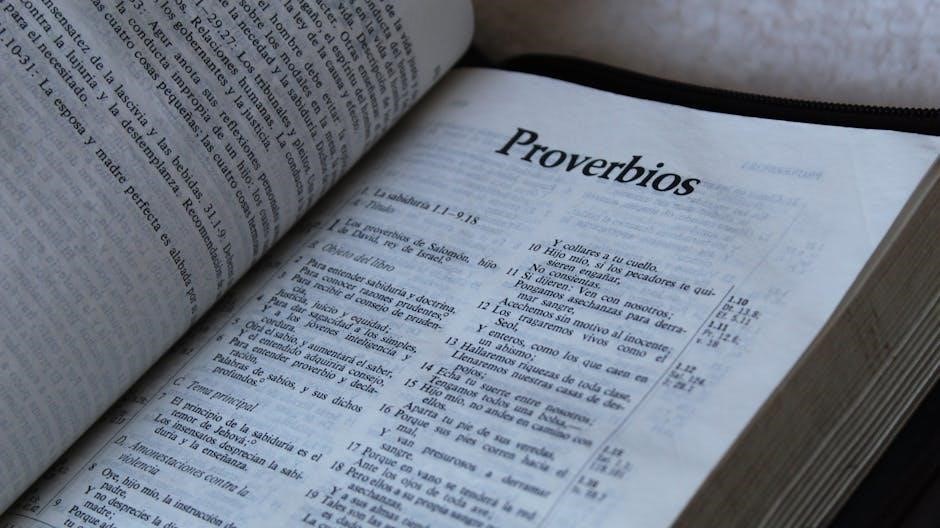
Furthermore, these chapters underscore the intimate connection between wisdom and the “fear of the Lord,” defining it not as mere terror, but as reverence, respect, and a deep understanding of God’s character. This foundational fear is presented as the wellspring of true knowledge and a life lived in harmony with divine principles.
Analyzing Proverbs 10-15: Core Principles
Proverbs 10-15 marks a shift towards a more concise, aphoristic style, presenting a wealth of individual proverbs that explore a diverse range of life experiences. These verses operate on the principle of parallelism, often contrasting righteous and wicked behavior to illuminate moral truths.
A recurring principle is the emphasis on diligence and hard work as pathways to prosperity, while laziness and sloth are consistently condemned. The importance of honest speech and the destructive power of deceitful tongues are also prominent themes, highlighting the value of integrity.
These chapters frequently address the dynamics of human relationships, emphasizing the benefits of humility, kindness, and forgiveness. Conversely, pride, anger, and strife are depicted as sources of conflict and ruin. The value of wise counsel and the dangers of rash decisions are also repeatedly underscored.
Observing these proverbs reveals a consistent worldview: righteousness leads to blessing, while wickedness ultimately results in consequences. They offer practical guidance for navigating daily life with wisdom and discernment, promoting a life of integrity and moral excellence.
Common Literary Devices Used
Proverbs masterfully employs several literary devices to convey its wisdom effectively. Parallelism, the most prominent, presents ideas in balanced phrases, reinforcing the message through repetition or contrast – a key stylistic element.
Imagery and metaphor are frequently used, painting vivid pictures to illustrate abstract concepts; for example, comparing wisdom to precious jewels or folly to a stumbling block. Personification imbues abstract qualities like wisdom or folly with human characteristics, making them relatable.
Chiasm, a mirrored structure, emphasizes key ideas by presenting them in a reversed order, creating a memorable and impactful statement. Merism utilizes paired opposites (e.g., “fool and wise”) to encompass the entirety of a concept.
Recognizing these devices enhances understanding, revealing the artistry and intentionality behind each proverb. They aren’t merely stylistic flourishes, but integral to the book’s pedagogical approach, aiding memorization and deeper comprehension of its timeless truths.

Resources for Studying Proverbs
Numerous commentaries, like those by Waltke and Henry, alongside online Bible study tools and concordances, greatly enrich the exploration of Proverbs’ wisdom.
These resources offer deeper insights into the historical context, linguistic nuances, and theological implications of each proverb, aiding comprehensive study.
Accessing these materials unlocks a richer understanding, facilitating a more profound connection with the book’s timeless principles and practical applications.
Commentaries: Bruce Waltke’s NICOT
Bruce Waltke’s New International Commentary on the Old Testament (NICOT) volume on Proverbs stands as a monumental achievement in biblical scholarship, widely considered the most comprehensive commentary available.
This two-volume work is meticulously researched, delving into the Hebrew text with exceptional depth, exploring its literary, historical, and theological dimensions.
Waltke skillfully employs new literary criticism, enhancing biblical interpretation and providing nuanced understandings of the proverbs’ original context and intended meaning.
He doesn’t shy away from complex linguistic analysis, offering detailed explanations of the Hebrew grammar and vocabulary, illuminating the subtleties of the text.
Scholars and serious students of Proverbs will find Waltke’s commentary invaluable for its thoroughness, insightful observations, and commitment to rigorous scholarship.
It’s a resource that empowers readers to engage with the book on a deeper level, unlocking its wisdom and applying its principles to contemporary life effectively.
However, its academic nature may require some familiarity with biblical studies to fully appreciate its depth and complexity, making it best suited for dedicated learners.
Matthew Henry’s Commentary
Matthew Henry’s Commentary on the Whole Bible, a classic and enduring resource, offers a devotional and practical approach to studying the Book of Proverbs, beloved by generations of Christians.
Unlike more technical commentaries, Henry’s work focuses on applying the wisdom of Proverbs to daily life, emphasizing its relevance for personal piety and spiritual growth.
His commentary is characterized by its clear, concise language and its emphasis on the moral and spiritual lessons embedded within each proverb, making it accessible to a wide audience.
Henry excels at explaining the practical implications of the proverbs, showing how they relate to issues of faith, family, work, and relationships, offering timeless guidance.
Available freely online through Bible Study Tools and other platforms, it’s an easily accessible resource for anyone seeking to deepen their understanding of Proverbs.
While less focused on detailed linguistic analysis than some modern commentaries, Henry’s devotional insights provide a valuable complement to more scholarly approaches.
It’s a wonderful resource for personal devotion, family Bible studies, and anyone desiring to live a life guided by biblical wisdom and practical application.
Online Bible Study Tools & Concordances
Numerous online resources significantly enhance the study of the Book of Proverbs, providing convenient access to various tools for deeper exploration and understanding of its wisdom.
Bible Study Tools, for example, offers a wealth of resources, including the complete text of Proverbs, commentaries from scholars like Matthew Henry, and interlinear Bibles.
Concordances, available on many platforms, allow users to search for specific words and phrases within Proverbs, revealing patterns and connections in the text.
Online dictionaries and lexicons provide definitions of Hebrew words, shedding light on the original meaning and nuances of the proverbs’ language.
Interactive Bible study websites often feature articles, videos, and discussion forums, fostering a community of learners and facilitating deeper engagement.
These digital tools empower individuals to conduct independent research, compare different interpretations, and gain a more comprehensive grasp of Proverbs’ teachings.
Utilizing these resources alongside traditional commentaries can create a rich and rewarding study experience, unlocking the timeless wisdom within the book.

Applying Proverbs to Daily Life
Proverbs offers practical wisdom for navigating relationships, finances, and ethical dilemmas, guiding us toward righteous living and sound decision-making daily.
Implementing these principles fosters integrity, improves communication, and cultivates a life aligned with God’s will, enriching our experiences.
By embracing Proverbs’ teachings, we can build stronger connections, manage resources wisely, and make choices that honor both ourselves and others.
Practical Wisdom for Relationships
Proverbs provides invaluable guidance for cultivating healthy and harmonious relationships, emphasizing the importance of thoughtful communication and genuine connection. The book stresses the power of kind words, urging us to avoid harsh speech and embrace gentle responses, fostering understanding and preventing conflict (Proverbs 15:1).
Furthermore, Proverbs highlights the significance of loyalty and trustworthiness in friendships, advocating for steadfast companionship and mutual support. It cautions against the dangers of gossip and encourages discretion in our interactions with others (Proverbs 17:17, Proverbs 20:19).
The book also addresses the dynamics within families, emphasizing the value of parental guidance and the importance of honoring one’s parents. It offers wisdom on resolving disputes and fostering a loving and respectful home environment. Applying these principles can lead to deeper, more fulfilling relationships built on a foundation of trust, respect, and genuine care.
Ultimately, Proverbs teaches us that healthy relationships require intentional effort, consistent kindness, and a commitment to prioritizing the well-being of others.

Financial Principles from Proverbs
Proverbs offers surprisingly relevant and practical advice regarding financial stewardship, emphasizing the virtues of diligence, planning, and responsible resource management. The book consistently warns against the dangers of laziness and encourages hard work as the foundation of financial stability (Proverbs 10:4, Proverbs 13:11).
Proverbs also advocates for careful planning and saving, urging individuals to prepare for the future and avoid impulsive spending. It highlights the importance of avoiding debt and cautions against the risks of co-signing loans (Proverbs 22:7).
Furthermore, the book stresses the ethical implications of wealth, encouraging generosity and compassion towards the less fortunate. It warns against the pursuit of riches at the expense of integrity and emphasizes the importance of honest dealings (Proverbs 11:1).
Applying these principles can lead to financial freedom, security, and a sense of contentment, aligning one’s financial life with biblical values.
Ethical Considerations and Decision-Making
Proverbs profoundly shapes ethical frameworks, emphasizing integrity, honesty, and righteousness as cornerstones of wise decision-making. The book consistently contrasts the paths of the righteous and the wicked, illustrating the consequences of ethical choices (Proverbs 1:7, Proverbs 2:20-22).
Proverbs advocates for fairness in all dealings, condemning deceit, slander, and partiality. It stresses the importance of speaking truthfully and acting with justice, even when it’s difficult (Proverbs 12:22, Proverbs 16:13).
The book also highlights the significance of self-control, urging individuals to manage their emotions and impulses, particularly anger. It emphasizes the value of humility and warns against pride, which can lead to poor judgment (Proverbs 16:18-19).
By internalizing these ethical principles, individuals can navigate complex situations with wisdom and make decisions that honor God and benefit others.